
Digital reputation management is the practice of actively monitoring, influencing, and shaping your online presence to build trust with both people and AI systems. It functions as a strategic operational asset, acting as a trust shortcut for humans and a primary ranking signal for AI-powered search. The field integrates SEO, public relations, and proactive content publishing. It is far more than image control. As AI-generated responses increasingly rely on consistent, authentic digital signals, your online presence either works for you or against you, with no neutral ground.
What are the core components of digital reputation management?
Effective digital reputation management follows a continuous 4-step cycle: audit, monitor, respond, and publish. Each step feeds the next, and skipping any one of them creates gaps that negative content fills quickly.
Step 1: Audit your digital footprint. Search your name or brand in an incognito browser window. This removes personalization filters and shows what a stranger actually sees. Scan Google, Bing, LinkedIn, Glassdoor, Yelp, Reddit, and any industry-specific platforms relevant to your field. Document every result on the first three pages.

Step 2: Set up real-time monitoring. Google Alerts covers the basics, but professional monitoring tools aggregate mentions across social media, news sites, forums, and review platforms simultaneously. The goal is to know about a negative mention within hours, not weeks.
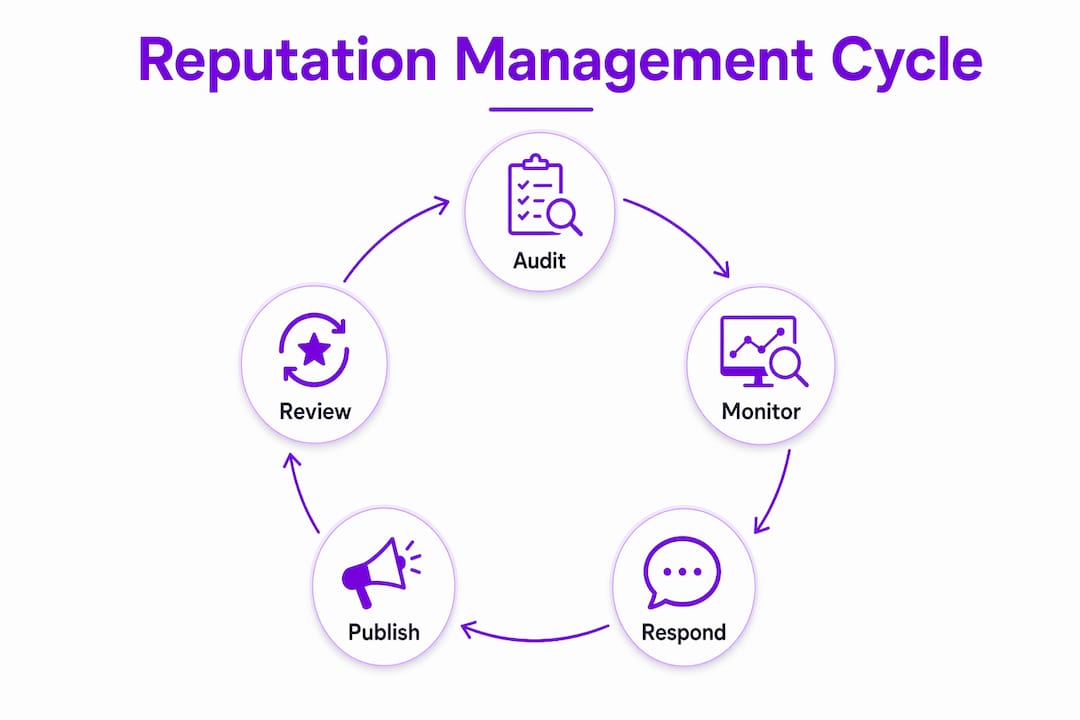
Step 3: Respond with human-centered engagement. Reply to reviews, address criticism directly, and acknowledge positive feedback. Silence reads as indifference. A measured, factual response to a negative review consistently outperforms ignoring it.
Step 4: Publish authoritative content consistently. Consistent publishing outranks negative signals sustainably. Blog posts, LinkedIn articles, press mentions, and case studies all create positive content that pushes unfavorable results down in search rankings.
Pro Tip: Set a weekly calendar block of 30 minutes specifically for reputation review. Professionals who treat this as a fixed appointment catch issues before they escalate.
How do human perception and AI algorithmic reputation differ?
The distinction matters because you are managing two audiences at once, and they evaluate you by completely different criteria.
Humans evaluate reputation primarily through shared social media content, with a study of 45 UK social media users in march 2026 revealing a dual-layer pattern. Passive consumption is the default. Deeper scrutiny kicks in only when content contradicts the viewer's existing beliefs or professional knowledge. This means a single inconsistent post can trigger far more critical analysis than dozens of neutral ones.
AI systems operate differently. Algorithmic reputation is built from SEO performance, volume and quality of mentions, review consistency, and coherence across platforms. AI does not read between the lines. It measures entity authority through signals it can quantify.
"Digital reputation serves as a 'trust infrastructure' that determines both human trust and AI recommendations. Consistency and transparency are the foundation. Artificial or overly promotional content actively weakens authority rather than building it."
The practical implication is clear. You cannot game one audience without damaging the other. A brand that floods the web with promotional content may see short-term SEO gains, but Large Language Models weight consistency and transparency, and overly promotional signals reduce authority scores over time. The only durable strategy is genuine, helpful content that serves real people and satisfies algorithmic criteria simultaneously.
- Synthetic reputation: Content you create and publish directly, including articles, social posts, and press releases
- Search-engine reputation: How search algorithms rank and surface your content based on authority signals
- Platform reputation: Reviews, ratings, and mentions on third-party sites like Google Business, Glassdoor, and LinkedIn
Managing all three modalities together is what separates professionals who maintain strong digital reputations from those who react to crises after the damage is done.
What tools and strategies support proactive reputation management?
The right tools reduce the time cost of reputation management from hours to minutes per week. The right strategy determines whether those tools produce lasting results.
Monitoring and aggregation platforms
Reputation management software aggregates mentions, reviews, and sentiment signals from hundreds of sources into a single dashboard. This gives you instant visibility across channels without manually checking each platform. Sentiment analysis flags whether a spike in mentions is positive or negative, so you can prioritize your response accordingly.
Real-time alerting is the feature that matters most. Structural changes in SERP reveal reputation risk earlier than ranking position changes alone. A new negative article may not drop your rankings immediately, but it will alter the composition of your search results page in ways that signal trouble ahead. Catching this early gives you time to respond before the narrative solidifies.
Content strategy for reputation defense
Publishing positive content is not about hiding negative reality. Building a digital reputation means earning trust through helpful, consistent content that outranks negatives on merit. The most effective content types for reputation defense include:
- Long-form articles that demonstrate expertise in your field
- Verified case studies and client testimonials
- Media coverage and third-party endorsements
- Active, well-maintained profiles on high-authority platforms
Pro Tip: Claim and fully complete your profiles on every major platform, even ones you do not actively use. An empty profile is a vulnerability. A complete one is a trust signal.
SERP footprint modeling
Search perception intelligence uses SERP footprint and narrative drift modeling to detect evolving reputation issues earlier than traditional ranking tools. This approach tracks not just where you rank, but what the overall composition of your search results communicates about you. A results page dominated by news articles, LinkedIn profiles, and your own website tells a very different story than one mixed with forum complaints and anonymous review sites.
Monitoring this structural shift weekly gives you a leading indicator of reputation health. By the time a reputation problem shows up as a ranking drop, the narrative has already shifted in ways that are harder to reverse.
How do you measure the success of your reputation efforts?
Measurement turns reputation management from a feeling into a fact. Without defined metrics, you cannot tell whether your efforts are working or whether you are spending time on the wrong activities.
The core KPIs for tracking reputation health are:
- Reputation score: A composite metric calculated by monitoring platforms based on review ratings, sentiment, and mention volume
- Sentiment trend: The ratio of positive to negative mentions over time, tracked weekly
- Review volume: Total number of new reviews across platforms, with a focus on response rate
- SERP composition: The types and sources of results appearing on page one for your name or brand
- Share of voice: How often your brand appears in relevant conversations compared to others in your category
AI-driven insight scores detect narrative shifts preemptively, flagging changes in how your brand is described across the web before those changes affect rankings. This is the difference between managing reputation and reacting to reputation damage.
Assign clear ownership for each metric. A reputation score without an accountable owner does not improve. Monthly reporting against baseline measurements shows whether your content and engagement strategy is producing measurable gains. Quarterly reviews allow you to adjust tactics based on what the data shows rather than what feels right.
Key Takeaways
Effective digital reputation management requires consistent action across both human-facing and algorithmic channels, combining auditing, monitoring, content publishing, and measurable KPIs into a single repeatable system.
| Point | Details |
|---|---|
| Reputation is a strategic asset | Your online presence acts as a trust signal for people and a ranking factor for AI systems simultaneously. |
| The 4-step cycle is non-negotiable | Audit, monitor, respond, and publish consistently to prevent gaps that negative content fills. |
| Human and AI audiences differ | Humans scrutinize contradictions; AI systems measure entity authority through consistency and coherence. |
| Content outranks suppression | Publishing authoritative, helpful content is more durable than any reactive removal strategy. |
| Measure with specific KPIs | Track reputation score, sentiment trend, review volume, and SERP composition on a weekly basis. |
The line between proactive and reactive is where reputations are won or lost
I have watched professionals spend months trying to repair damage that a few weeks of proactive management would have prevented entirely. The reactive mindset is understandable. Reputation feels abstract until something goes wrong. But by the time a damaging article ranks on page one or a wave of negative reviews lands, the cost in time, money, and credibility has already multiplied.
The shift I find most important in 2026 is the blurring of professional and personal digital identity. Your LinkedIn profile, your Twitter history, your name in a news article, and your Google Business reviews are all part of one unified picture. Treating them as separate is the first mistake most professionals make.
The second mistake is trusting artificial content fixes. I have seen brands flood the web with low-quality press releases and keyword-stuffed articles, believing volume would solve the problem. It does not. AI systems recognize promotional content patterns and reduce authority scores accordingly. Human readers notice the lack of substance and disengage. The only thing that works is genuine expertise, published consistently, over time.
The third insight I would offer is this: human judgment still matters more than any tool. Monitoring software tells you what is happening. It does not tell you what it means or how to respond. The professionals who manage their reputations best are the ones who read the signals, think critically about the narrative, and make deliberate choices about what to publish and when.
— Adel
Levelup and the future of verifiable reputation
Reputation built on self-reported claims has a credibility ceiling. Levelup removes that ceiling entirely.

Levelup is a proof-based growth platform built on the Solana blockchain. Every achievement is verified by human reviewers and recorded permanently on-chain, making fabrication impossible. For professionals who want their digital reputation to reflect real, documented progress rather than polished self-promotion, Levelup provides the infrastructure to build a reputation that holds up to scrutiny. Users complete real-world missions, submit proof, and earn both XP and $GROW tokens as verifiable markers of genuine development. If your reputation strategy depends on trust, Levelup gives you something concrete to point to.
FAQ
What is digital reputation management?
Digital reputation management is the ongoing process of monitoring, influencing, and shaping how you or your brand appear online. It combines SEO, content publishing, review management, and real-time monitoring to build trust with both people and AI systems.
How often should I review my digital reputation?
Proactive weekly reviews across 50+ platforms reduce risk most effectively. Set a fixed weekly appointment for monitoring and a monthly session for deeper KPI analysis.
Can negative search results be removed?
Most negative content cannot be removed unless it violates platform policies or legal standards. The proven alternative is publishing authoritative, helpful content that outranks negative results through consistent SEO and PR effort.
How does AI affect my online reputation?
AI systems build algorithmic reputation from entity authority signals including SEO performance, review consistency, and coherence across platforms. Overly promotional or inconsistent content reduces your authority score with AI systems.
What metrics best measure reputation health?
The most reliable metrics are reputation score, sentiment trend, review volume, and SERP composition. Tracking these weekly gives you early warning of narrative shifts before they affect rankings or trust.